
Best SIM Card for Australia: What I Actually Use [2026]
Choosing an Australia sim card for tourist use or eSIM is genuinely confusing. There are dozens of options, the prices change constantly, and most comparison articles are written by people who have never actually used the products they’re recommendingI split my time between Australia and Thailand and have been using Australian SIM cards and eSIMs continuously across both short and extended stays over the past year. I’ve worked my way through four options — Felix, Saily, Vodafone and Airalo — across city and regional travel. Here’s what I use, what I’d recommend to different types of travellers, and what I’d skip.
This post contains affiliate links. Our full disclosure policy is here.
Is your phone compatible with the Aussie network?
Most modern phones manufactured after 2020 will work in Australia without any issues. The country uses standard GSM networks and supports both 4G and 5G. A few things to check before you travel:
- Physical SIM: your phone needs to be unlocked.
- eSIM: your phone must be eSIM compatible — check your settings or the manufacturer’s website.
- 5G: your device needs to support Australian 5G bands (n78 at 3500 MHz is the most common).
Remote travel: if you’re heading outback, Telstra network coverage is the priority — other networks thin out quickly once you leave the main highways.
The Three Ways to Get Connected
Before getting into specific products, it’s worth understanding the three main options.
eSIM (Digital SIM)
The easiest option for most travellers in 2026. You purchase and activate online before you leave home, there’s nothing physical to lose, and you can keep your existing SIM in the phone at the same time. Works on any eSIM-compatible device. This is what I use most of the time.
Physical SIM Card
Still a solid option, particularly if your phone isn’t eSIM compatible. You can buy one at the airport, from any major carrier store in a shopping centre, or from Coles or Woolworths. You’ll need to provide your name, passport number and an address (your hotel is fine) to activate it.
International Roaming
Convenient for very short trips but almost always expensive. Check with your home carrier for daily or weekly pass options before you leave. For anything longer than a few days, a local SIM or eSIM will save you money.
My Honest Verdicts After a Year of Use
I’ve tested four products over the past year. Here’s the short version of each.
Felix Mobile — Best for Long-Term Australian Stays
Felix is my go-to for long-term use. It runs on the Telstra network, which means solid coverage across cities and reasonable reach into regional areas. The standout is their half-price deal — it’s been running for well over a year now and makes Felix genuinely competitive on price for what you get. If you’re on a Digital Nomad Visa or spending more than a month in Australia, Felix is the one I’d point you to first. Unlimited data plans are available, which matters if you’re working remotely.
Saily — Best eSIM for Regional Travel (+Revolut Users)
Saily is an eSIM that runs on the Telstra network, which is the network you want if you’re doing any travel outside major cities. The reason I recommend it specifically for Revolut users is the integration — if you’re already using Revolut for travel money, adding a Saily eSIM through the same app is straightforward and the pricing is competitive. It’s also my preference for regional and outback travel where network coverage is non-negotiable.
Vodafone — Fine for Cities, Limited in Regional Areas
Vodafone (now part of TPG) works well enough in Sydney, Melbourne and other major cities, and the pricing is generally competitive. The limitation is coverage — once you head into regional areas, the network thins out noticeably compared to Telstra. If your trip is city-based, it’s a reasonable option. If you’re planning any regional driving or outback travel, choose a Telstra-network option instead.
Airalo — Convenient If You Already Have It
Airalo is one of the most widely known eSIM providers internationally and works in Australia. It’s not the best value option here compared to buying direct from an Australian provider, but if you’re already an Airalo user and arriving for a short stay, it’s not a bad option. I wouldn’t go out of my way to sign up for it specifically for an Australia trip.
Which Australia SIM Card Is Right for You?
Short-Term Visitors (Under 2 Weeks)
An eSIM is the easiest option — activate before you leave, no airport queues. If your trip is city-based, Optus or Vodafone network options are competitive on price. If you’re covering regional areas or doing a road trip, choose a Telstra network eSIM (Saily is a good option here) and pay the small price premium for the coverage.


Long-Term Stays and Digital Nomads (1 Month+)
Felix is the clear recommendation. The half-price deal makes it excellent value for ongoing use, it runs on the Telstra network, and the unlimited data option is available if you need it for work. You’ll need a physical SIM for Felix — order it online and have it shipped to your accommodation, or pick up at a store.


Regional and Outback Travel
Telstra network, without question. Either a Telstra direct SIM or a Telstra-network eSIM that uses the Telstra network. Coverage in remote areas is genuinely important for safety as much as connectivity — this is not the place to cut costs on network quality.
Revolut Users
Saily integrates directly with Revolut, which makes it the simplest eSIM option if you’re already using Revolut as your travel card. Telstra network coverage is a bonus.
Groups and Families
Individual eSIMs for each person is usually the most straightforward approach. A pocket WiFi device is an alternative if you have multiple devices and want a single shared connection — see the section below.
Australia’s Three Mobile Networks
All SIM cards and eSIMs in Australia run on one of three underlying networks. Understanding which network a product uses matters more than the brand name on the packet.
- Telstra has the largest network with the best rural and remote coverage, and the most advanced 5G rollout. It’s the premium option and prices reflect that, but many MVNOs (third-party providers) run on the Telstra network at lower prices — Felix and Saily are both examples.
- Optus has strong coverage in metropolitan and most regional areas. Good balance of coverage and cost for city-based travel. Less reliable once you’re in genuinely remote areas.
- TPG/Vodafone (merged network) is competitive in urban areas with some of the most affordable pricing. Coverage drops off in regional and rural areas. Best suited to city trips.
Most tourist-focused SIM products are sold by MVNOs — companies that resell access to one of these three networks, usually at lower prices than going direct. Always check which underlying network a product uses before buying.
Where to Buy a SIM Card in Australia
If you’re buying an eSIM, purchase online before you leave home and activate on arrival — no queuing required.
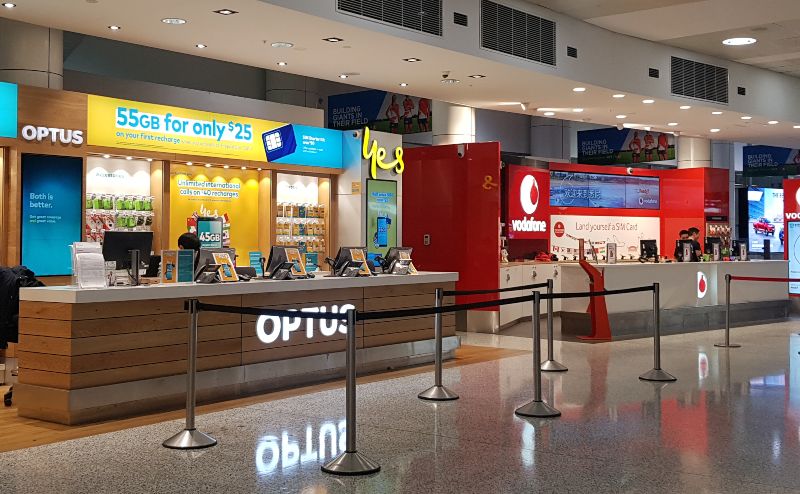
For a physical SIM card, your options are:
- Airport: all major international airports have carrier counters and vending machines airside or in arrivals. Convenient but prices are sometimes higher than in-store.
- Carrier stores: Telstra, Optus and Vodafone stores are in every major shopping centre. Staff can help with activation.
- Supermarkets: Coles and Woolworths stock prepaid SIMs from several providers. Good value and widely available.
- Online delivery: some providers will ship a SIM to your Australian accommodation before you arrive.
To activate any service you’ll need your name, passport number, an Australian address (your hotel or hostel is fine) and a payment method. Most activate within minutes.
Pocket WiFi — Is It Worth It?
A portable WiFi device can make sense for groups travelling together with multiple devices, or for travellers whose phones aren’t compatible with Australian networks. Modern devices offer 5G in major cities, up to 12 hours of battery life and connections for up to 10 devices.
For most solo travellers or couples, individual eSIMs will be more straightforward and cost-effective. Pocket WiFi becomes better value when you’re splitting the cost across a group or running multiple devices simultaneously.
Rental costs typically run $10–15 per day for short-term hire or $90–120 per month. Check current pricing directly with providers as rates vary.
Emergency Calls and Public Wi-Fi
Even without an active SIM or any network connection, all mobile phones in Australia can dial 000 (or 112) for emergencies. The phone will connect to any available network for emergency calls.
Free public Wi-Fi is available in most city centres, libraries, major shopping centres, most hotels and hostels, and chain cafes. Note that public Wi-Fi is not always secure — use a VPN if you’re accessing sensitive accounts.
How Much Data Do You Actually Need?
A rough guide to data consumption:
- Google Maps navigation: around 5MB per hour
- Social media browsing: around 100MB per hour
- Video streaming (standard quality): around 1GB per hour
- Video calls: around 500MB per hour
For a typical two-week holiday with regular maps, social media and occasional streaming, 15–20GB is usually sufficient. If you’re working remotely or doing heavy video calls, go for an unlimited plan.
Need more ideas? Join our Australia Travel Tips group where you can ask questions, stay updated with what’s happening and meet a bunch of friendly local experts ready to share their advice!